

It’s not often that I see a new academic paper specifically about morbid curiosity, so I get excited when one comes my way. Usually I am a reviewer on those manuscripts since I’m one of the few people who studies morbid curiosity, but this one caught me by surprise. It was also a theoretical paper, which was even more surprising! So, I thought I’d review it here.
Morbid Curiosity as an Adapted Motivation to Explore Ambiguous but Survival-Relevant Stimuli by David March was published in Psychological Review this week.
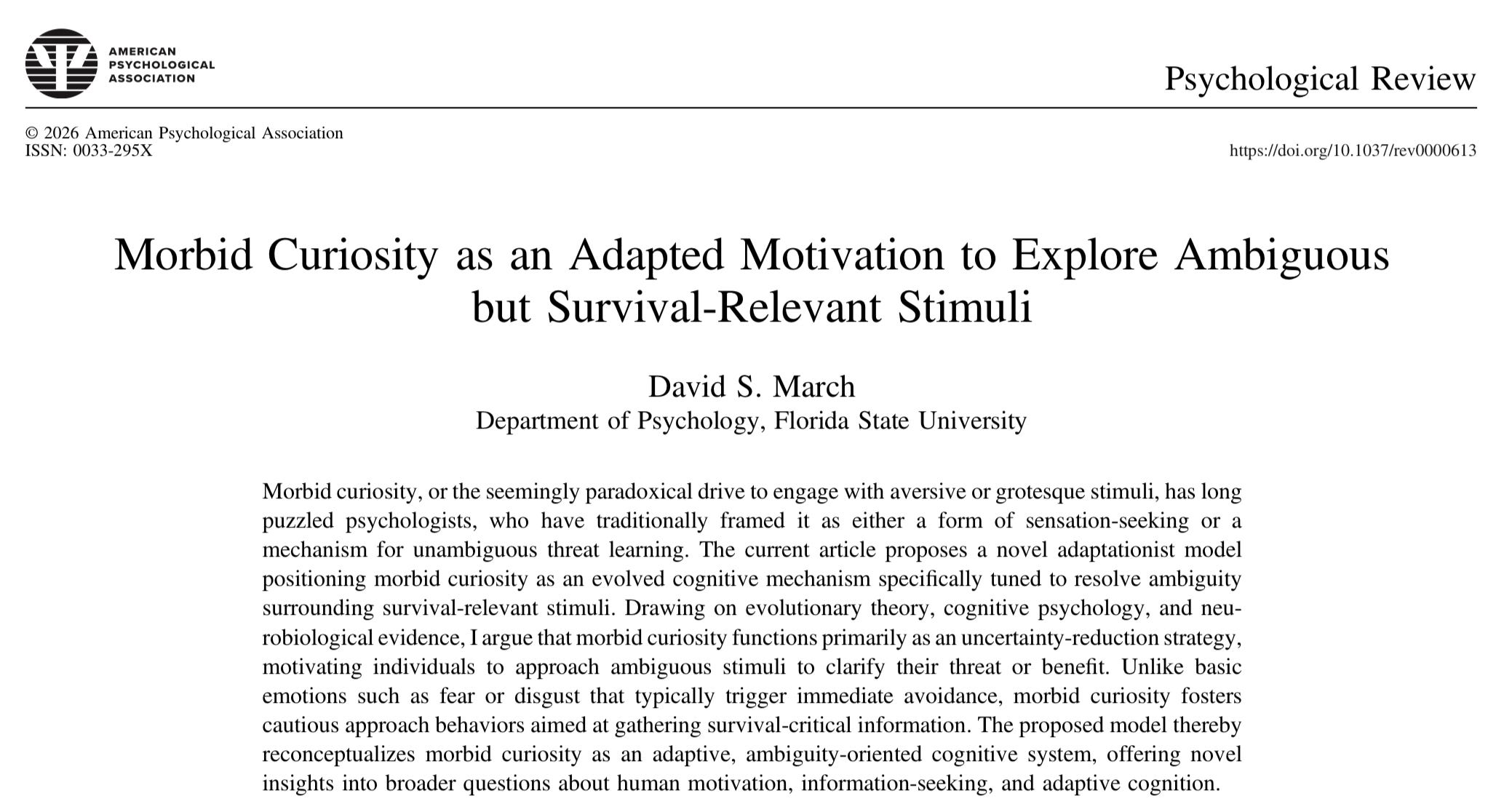
In it, the author operationalizes morbid curiosity as an
“automatically activated (though not necessarily nonconscious) attentional approach state toward ambiguous, but potentially survival-relevant stimuli with the integrated goals of (a) determining the nature of the stimuli (danger, opportunity, both, or neither) and (b) gathering immediate and future survival-relevant information.”
To me, this sounds a bit too broad for morbid curiosity. After all, many things unrelated to threat or danger can be survival-relevant (resources, threats, social partners). It sounds more like curiosity in general. The author clarifies a few lines later, saying that it is threat-ambiguous stimuli that trigger this state with the goal of identifying whether or not avoidance is necessary and if approach may be beneficial.
This sounds akin to what is going on in predator inspection. Here, we probably agree.
Setting up his theory as distinct, March argues that his conceptualization is anchored in an evolutionary rationale. I thought this was a strange argument, as my own work has very clearly anchored morbid curiosity in evolutionary rationale. This is crystal clear throughout my book (which, to be fair, March probably had not read before writing this paper).
So far, the distinction of this conceptualizes lies in the focus on resolving ambiguity or uncertainty. Interestingly, this reminded me of Frank McAndrew’s work on creepiness, which makes a very similar argument about ambiguity of threat. Unfortunately, the research on creepiness was not cited in the paper.
