

The horror genre has been on a march to success over the past decade. Following a big year in 2017 with blockbusters like IT, The Mummy, Get Out, and Split, horror finally broke away from its flatline trend of 5-6% of annual Box Office share.
Perhaps more surprising was the success of horror during the first two years of COVID, when the genre captured its highest share of the Box Office since records have been kept (though 2025 has since beaten this, and 2026 is looking to as well).
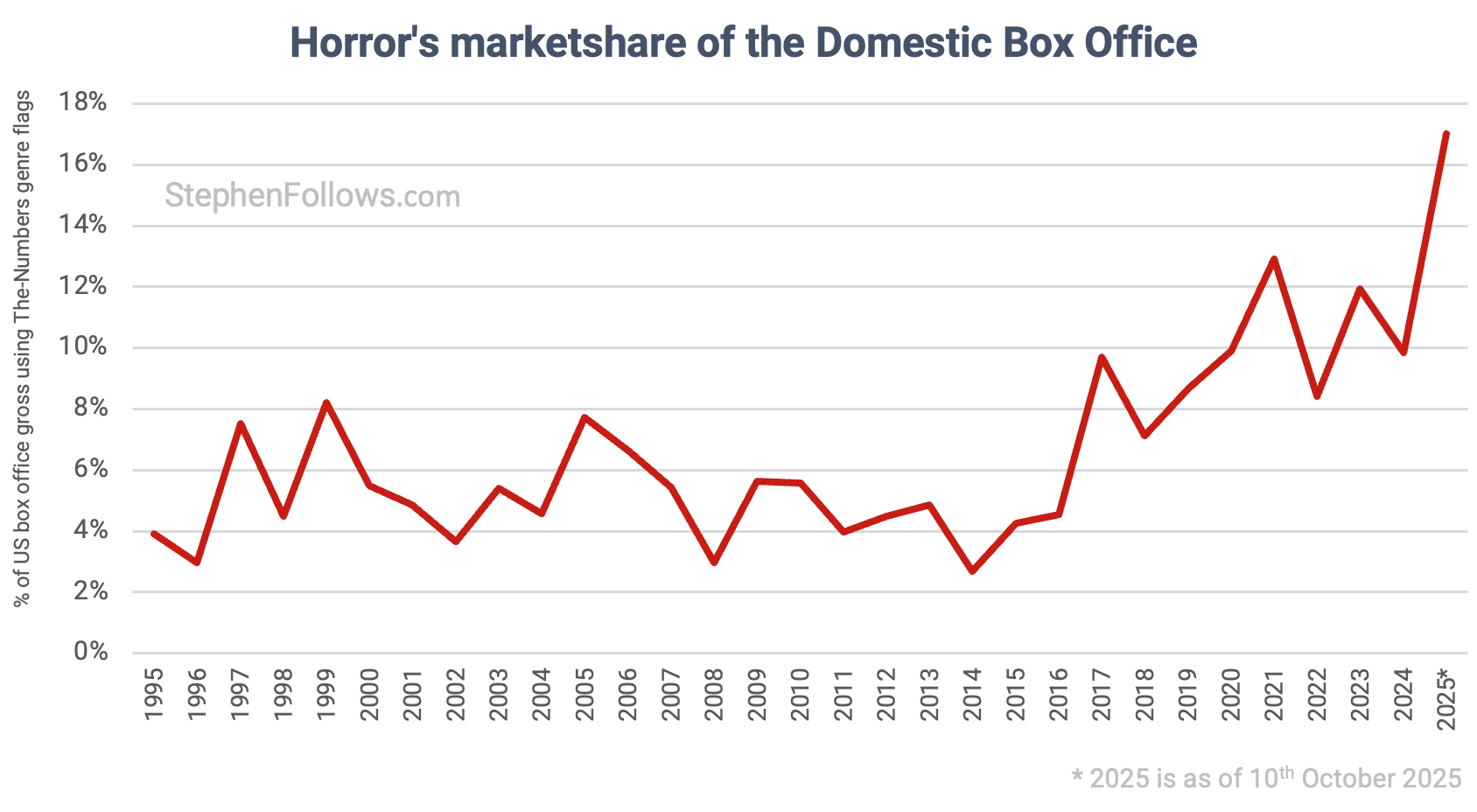
It’s difficult to pinpoint a reason for this surge. One is economics: horror films can be made with relatively small budgets and go on to generate tens or hundreds of millions of dollars in revenue. Blumhouse made their name with this method, spawning the wildly successful Paranormal Activity franchise. The biggest horror film of 2026, Obsession, followed this same trend, earning over half a billion dollars on a sub-$1 million budget.
But I’m not sure economics accounts for all of the success. After all, this has always been true of horror. You’ve never needed A-list actors or huge production budgets to scare up some money with a good horror story.
In a recent TIME article, I mentioned how successful horror films often mirror social anxieties of the period in which they were produced. That is not to say they were made with this intention in mind, but rather that audiences seem to reward the films that deal in our current fears. The beginning of the atomic age made Godzilla a success, the Cold War and Roswell had us flocking to theaters to see stories about alien body snatchers, and the focus on mental health over the past decade or so has found a home in “elevated” horror films.
I feel pretty confident that large-scale societal shifts influence the kinds of stories we consume. But I wonder how sensitive this shift really is. Do smaller events affect our taste for stories?
There’s at least one well-documented example in recent times. In April 2020, the decade-old pandemic film Contagion was at the height of its popularity. The film went from relative obscurity to the most popular movie in the world in a matter of weeks.
The reason?
Seemingly, a global pandemic.
In what is still my most cited academic paper, my colleagues and I found some evidence that simulating your fears through stories could be a good way to practice regulating those difficult emotions like fear and anxiety. In this case, we found that horror fans were more likely to score high on measures of psychological resilience during the early months of the pandemic, even when controlling for other demographic and personality factors that might influence resilience.
But COVID was still a pretty big event. It affected everybody on Earth in a completely novel way for multiple months, even years. What about smaller events? I’m thinking here of threatening or dangerous events that happen somewhat locally or regionally, and don’t last for more than a few days. Does a huge hurricane make us more interested in watching an apocalyptic weather movie like The Day After Tomorrow?
Well, let’s see.
Google Trends allows you to see how popular a particular search term is for a given date range. This is relative popularity, meaning the most popular day for a search term in a given range will score a 100, and everything else is scaled below that.
The modern streaming era began around 2007-2008, when Netflix and Hulu launched their services. So we can look up the US landfall dates of the costliest hurricanes between 2008 and 2026 and compare this to searches for the film The Day After Tomorrow.
The Day After Tomorrow isn’t a hurricane-specific film, but it is a widely known apocalyptic weather film that prominently features superstorms and tsunamis. For those in the path of a hurricane, The Day After Tomorrow is probably one of the first movies that would come to mind.
For our purposes, let’s look at the five most destructive hurricanes since 2008 whose primary damage was done in the continental US:
Harvey - August 25, 2017
Ian - September 28, 2022
Helene - September 26, 2024
Ida - August 29, 2021
Sandy - October 29, 2012
Now let’s see relative popularity of searches for The Day After Tomorrow in a one-month window on either side of these dates:
