

When we think of psychopathy, we tend to think of a “prototypical psychopath.” We imagine someone who cold, uncaring, unafraid, and manipulative. We often also think of them as criminal and prone to violence.
If we are to imagine a single individual who is the perfect prototypical psychopath, we might imagine Anton Chigurh.

In fact, across hundreds of movies, forensic psychologists have named Anton Chigurh one of the realistic, if extreme, versions of a psychopath in film, saying that
…there are sufficient arguments and detailed information about his behavior in the film to obtain a diagnosis of active, primary, idiopathic psychopathy, incapacity for love, absence of shame or remorse, lack of psychological insight, inability to learn from past experience, cold-blooded attitude, ruthlessness, total determination, and lack of empathy. He seems to be affectively invulnerable and resistant to any form of emotion or humanity.
While Chigurh may check all the boxes and represent the perfect psychopath, modern studies are beginning to challenge the notion of psychopathy as a unified psychological construct.
A recent network analysis paper looked at how measures from seven different psychopathy-related psychological instruments mapped onto sub-clinical psychopathy in 612 college students.
Network analysis allows researchers to see the interrelations and relative importance of subscales across a range of measures. It allows you to visualize and assess the “core” of several measures.
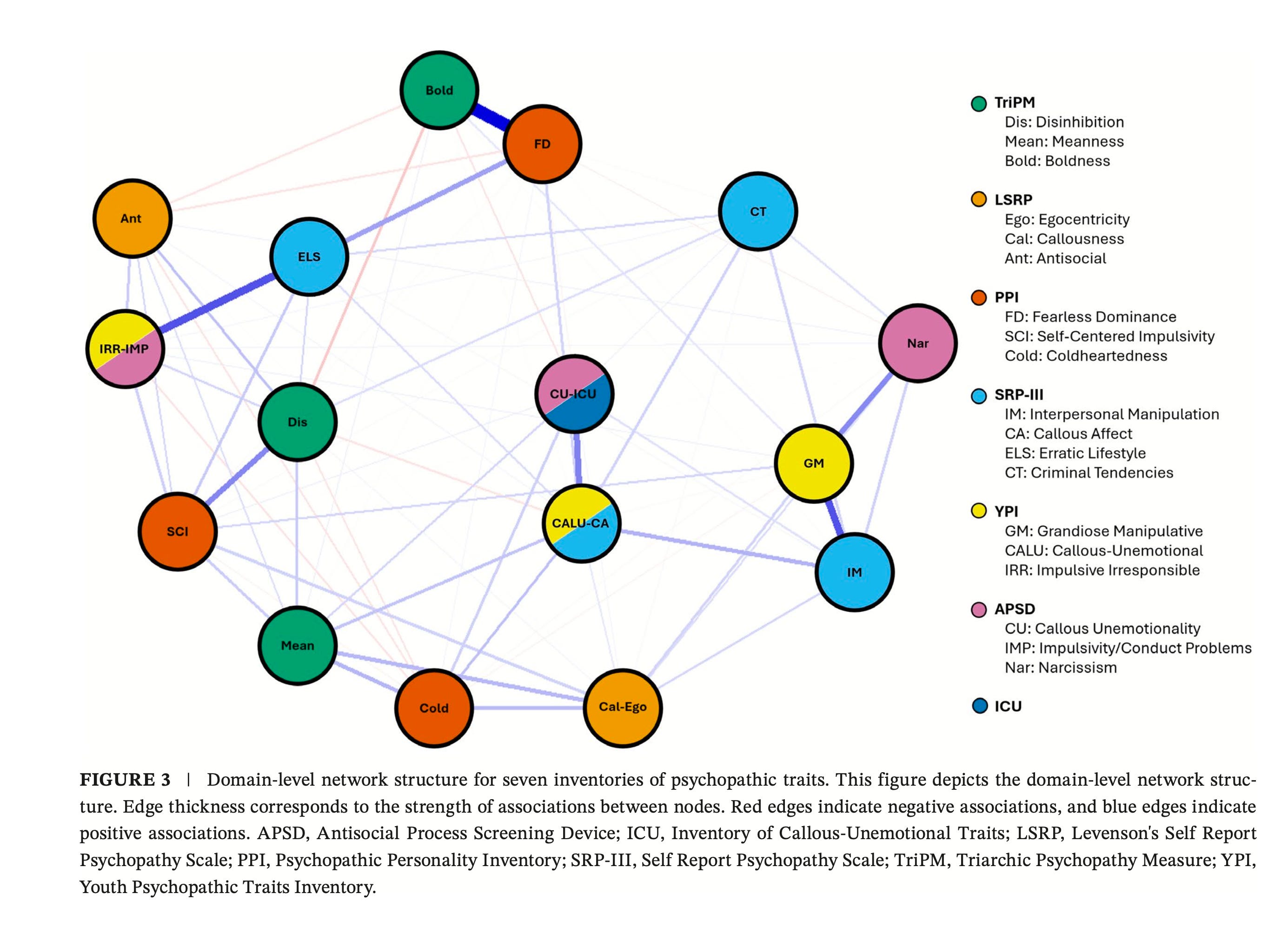
One of the most interesting things about this network analysis is that it suggests psychopathy is modular. The traits associated with psychopathy cluster together in meaningful ways, but they do not collapse into one indistinguishable mass. And perhaps most surprisingly, antisocial behavior and criminal tendencies are not nearly as central as many traditional theories of psychopathy would predict.
In forensic populations, criminality tends to dominate the picture because the samples themselves are partially defined by severe behavioral deviance. If you study incarcerated individuals or people selected for chronic antisocial behavior, then antisociality is naturally going to appear central to the construct.
Non-forensic samples like this one allow us to measure the interrelations between psychopathy-related traits outside of those selection pressures.
Looking at this network, there are three or four major regions.
