

As far as I know, nobody has ever conducted an academic study asking people which sub-genre of horror is scariest and tried to explain why this is the case.
I’ve asked this before on social media to get a pulse for it. Psychological horror usually comes out on top.
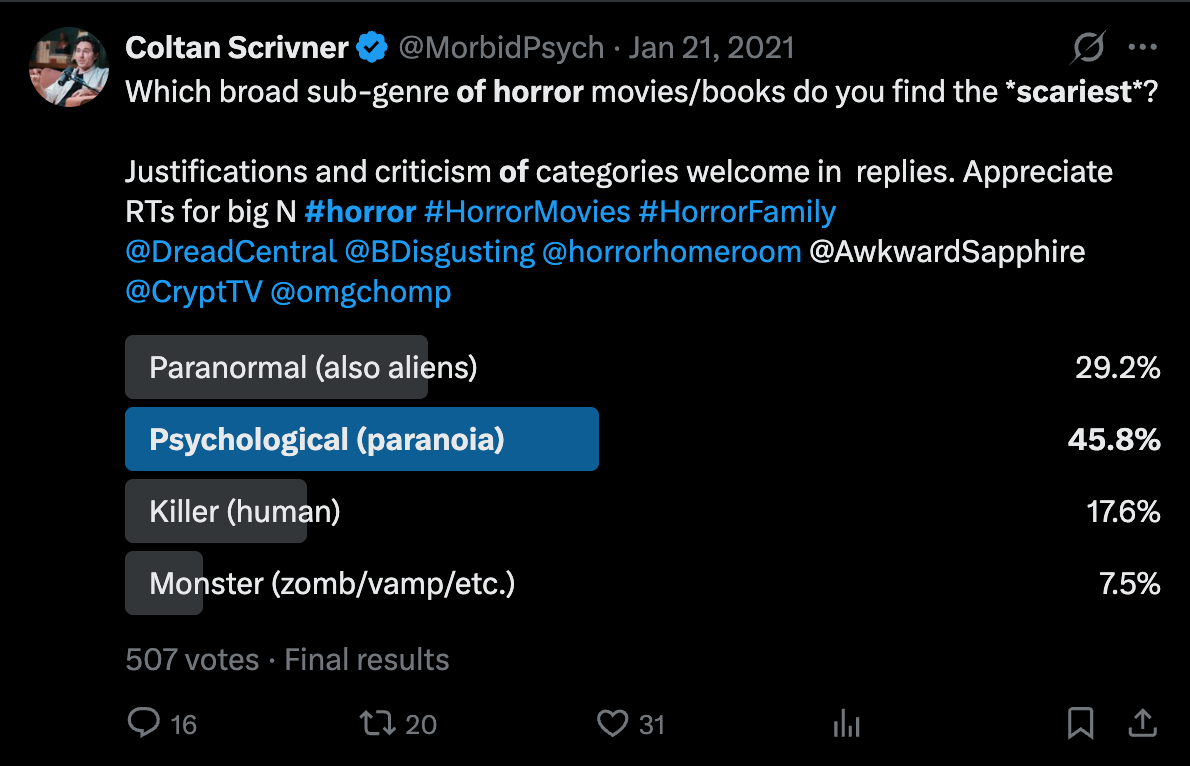
If it’s true that most people find psychological horror to be the scariest sub-genre, it would be a difficult observation to explain under current frameworks of fear. Much of the work on defining fear, including my own, has focused on external threats like predatory creatures and dangerous environments.
The defensive behaviors that often come along with fear suggest that the emotion functions, in part, to get us away from danger. When we feel afraid, we typically try to hide, flee, or seek out allies to support us. This makes sense in the context of a predator, but less so with paranoia.
Fear is also highly conserved in animals. The neural circuits and brain regions involved in a fear response are quite similar across a variety of different animals, suggesting that it serves an important function and helps solve a recurrent, evolutionarily old problem.
Perhaps focusing on the universal aspect of fear can help us reason about it from a first-principles framework and better understand how it functions. Ralph Adolphs, one of the preeminent scholars on the science of fear, suggests something similar:
“a fruitful starting point is to begin with a primitive concept of fear that is shared across mammals (or even more broadly than that), and then investigate the variations on this theme.”
If we want to understand why psychological horror is so frightening, we need a better grasp on what makes something frightening in the first place. Most scholars with a background similar to mine begin their inquiry into the nature of fear by studying the behaviors of rats or the activation of the amygdala. However, my work attempts to explain fear by understanding scary stories.
This gives me a slightly different angle to work from than most scientists. In some ways, my angle is more observational and makes fewer assumptions. Neuroscientists and psychologists typically must make assumptions about what should be frightening in order to test questions about fear. If I want to know what parts of the brain light up when we are afraid, I must take a small set of highly controlled stimuli that I assume will elicit fear and expose people to those stimuli while I measure brain activation.
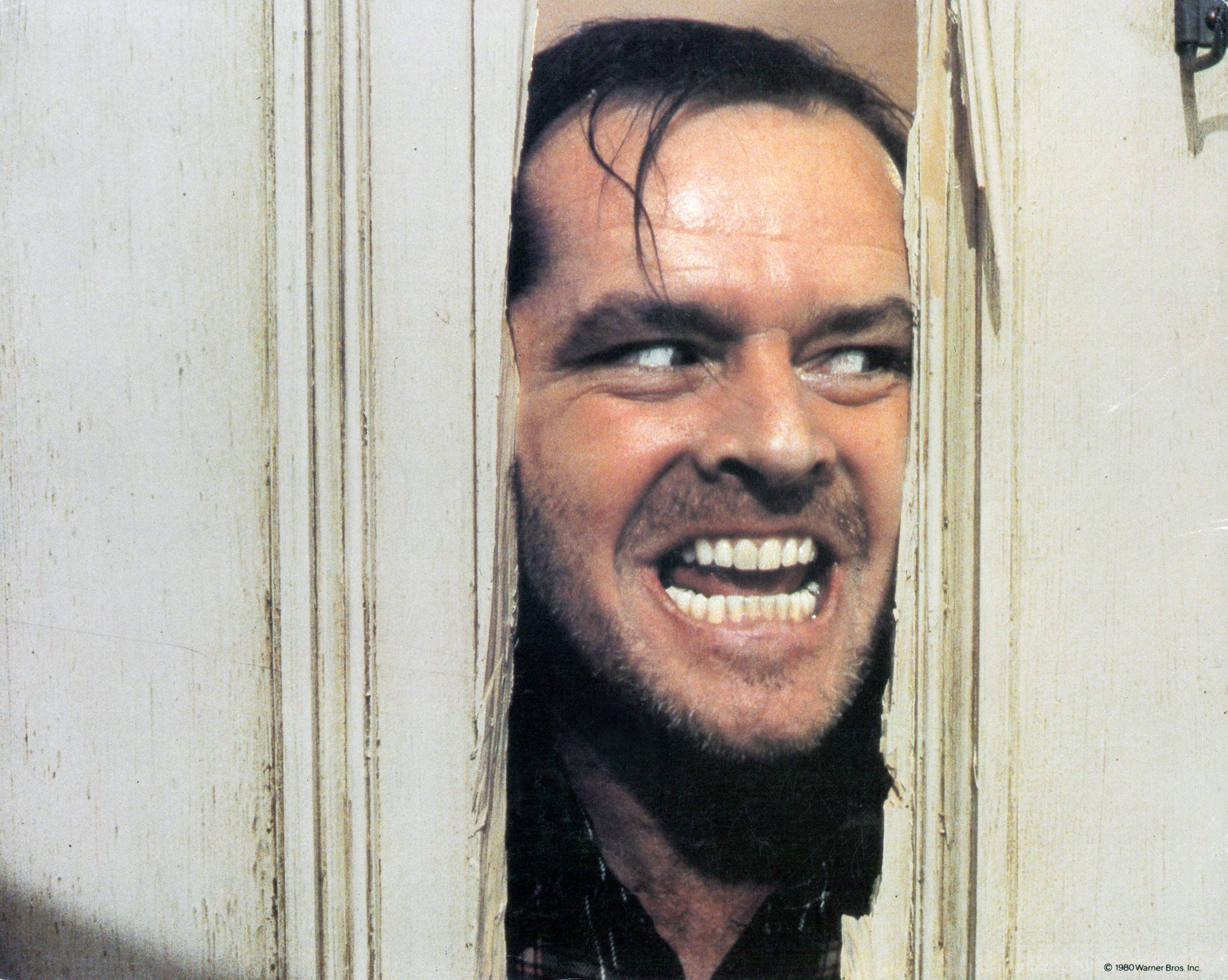
My approach is slightly different. I take what millions of people have already categorized as frightful and try to understand why those stories are categorized as such. What are the common features between Halloween, Saw, Dawn of the Dead, The Exorcist, and The Shining that make them terrifying?
Starting about a year ago, I began exploring a new definition of horror based on perceived formidability. This hypothesis was eventually refined and tested in an academic paper with Edgar Dubourg. We looked at nearly 600 films across several decades and found that films categorized as horror regularly had more formidable antagonists and less formidable protagonists.
While I think we got the foundation mostly correct, and it seems to explain horror better than other definitions, it doesn’t explain psychological horror very well. One answer to that is that psychological horror isn’t really horror (but that’s sort of a cop-out, isn’t it?). Another answer is that the basic computation isn’t exactly formidability, but something else that frequently loads onto it in stories.
I think I’ve discovered what that is.
